
Air Duct Cleaning: Repair or Replace? How Tremont Homeowners Decide
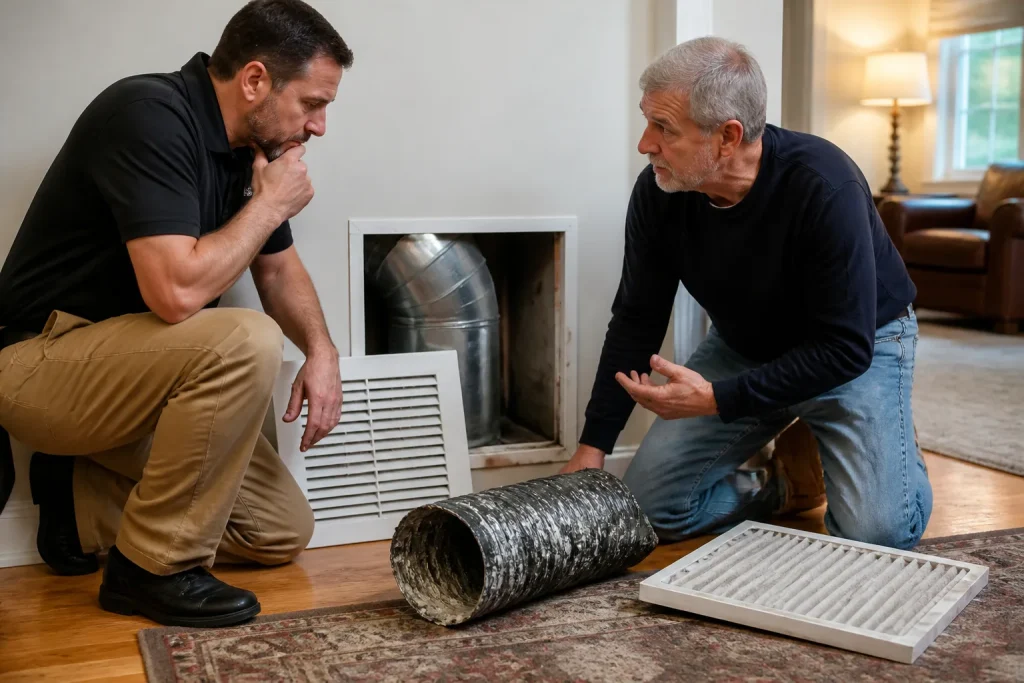
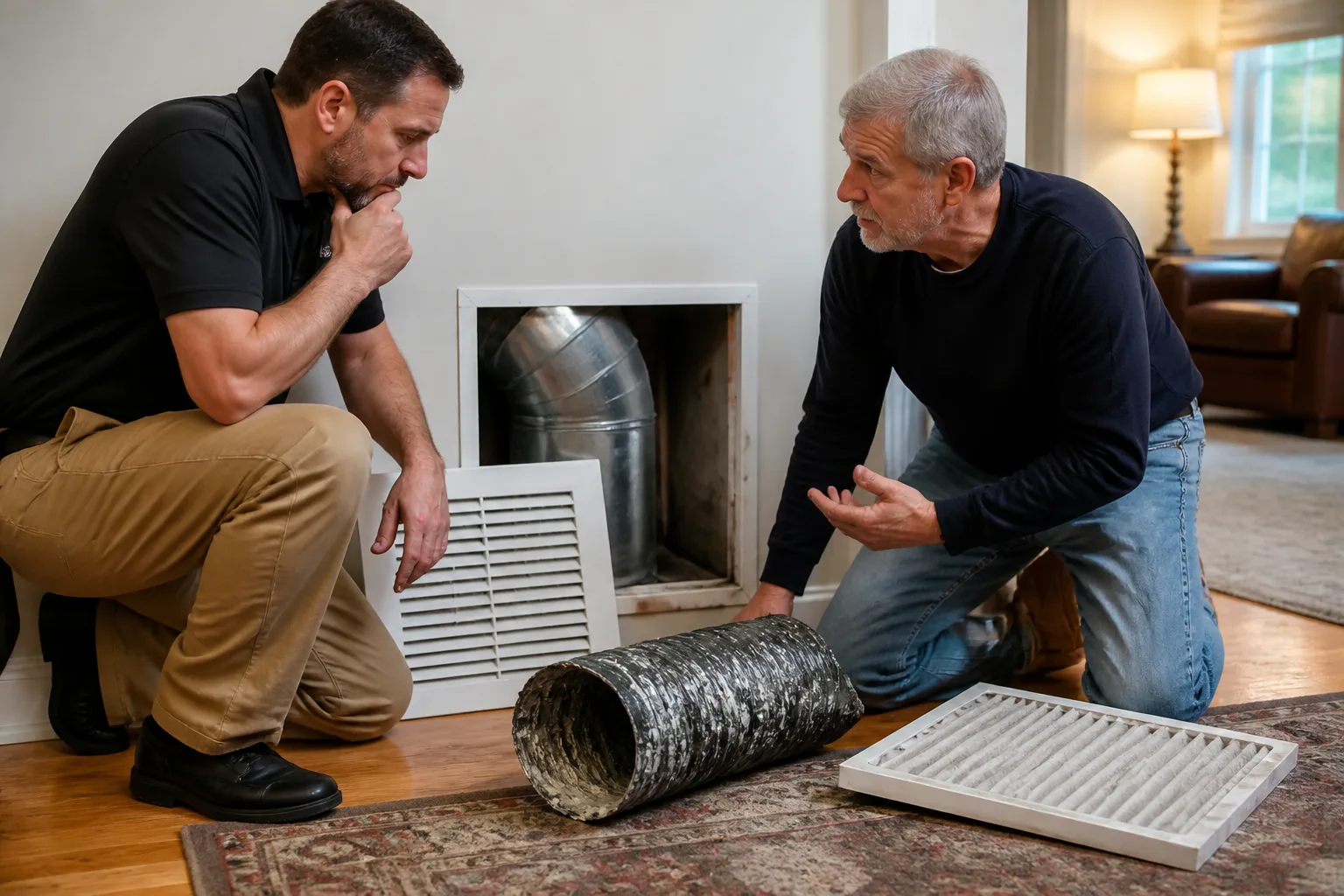
Most Tremont homeowners get told “clean it” or “replace it” by the same company that profits either way. That’s not a decision framework. The honest answer comes down to three things: whether your ducts still hold air, what material they’re made of, and what’s actually growing or sitting inside them. A leaky, crushed, or mold-colonized system doesn’t get better with cleaning. A sound system with ordinary dust does. This guide walks through how to tell the difference in Tremont, using the same criteria a careful technician should use.
What are the three real outcomes for a duct system?
Every duct system falls into one of three categories, and the category decides the scope of work. Cleaning alone is right when the ducts are structurally sound, joints are connected, and the contamination is ordinary dust and debris buildup. Clean and repair is right when the interior is contaminated but the system still has leaks, disconnected joints, or isolated crushed sections that can be sealed or replaced piece by piece. Full replacement is right when the material itself has failed or the contamination can’t be remediated in place. Getting placed in the wrong category is where homeowners overpay or, worse, pay for cleaning that changes nothing.
- Clean only: intact flex or sheet metal, sealed joints, ordinary household dust, no musty odor inside the system.
- Clean and repair: visible gaps at plenums, sagging flex runs, family of disconnected branches, isolated sections needing replacement.
- Full replacement: widespread mold colonization, saturated liner, rodent debris throughout, or ductboard with degraded interior facing.
Tremont’s housing stock spans a wide age range, from older frame homes with retrofit systems to newer construction with engineered flex. That means we see all three categories on any given block. The category is a technical call, not a sales call – and a technician who can’t walk you through why your system belongs in one bucket and not another is guessing. Our own work runs through the full air pathway, from Air Duct Cleaning Tremont through the air handling equipment itself, because the category usually becomes obvious once the system is opened and inspected.
Why is duct leakage the biggest replacement trigger?
Leakage is the first thing to assess before anyone reaches for a cleaning tool, and it’s the most common reason cleaning turns out to be the wrong spend. A system with significant air leakage loses conditioned air before it reaches living spaces, which means cleaning a compromised system is polishing a sieve. You pay for the cleaning, you still pay for the lost air, and the dust returns through the same gaps. The trigger isn’t age by itself – it’s whether the ductwork is intact and sealed.
Some leakage indicators a Tremont homeowner can spot without opening anything up:
- Disconnected joints: visible gaps where branches meet trunks, or tape peeled back at seams.
- Crushed flex sections: runs that sag, kink, or flatten where they pass through framing – a crushed section can’t carry air.
- Unsealed plenums: the box at the air handler with gaps or loose panels; sealing here alone can make a real difference.
- Pressure imbalance: rooms that stay stuffy while adjacent rooms are fine, which can point to a broken branch.
Air leakage also drags contaminated air into the system from unconditioned spaces – attics, crawl spaces, garage adjacency. That’s why we pair cleaning with Duct Repair & Sealing as a distinct step. We seal what we clean, because otherwise the same gaps feed the same problem back into the system.
What material lifespan benchmarks matter for Tremont homes?
Material sets the outer edge of what’s worth saving. These are general industry ranges, not rules:
- Flexible duct: 15-20 years, shorter when it’s been crushed, kinked, or exposed to heat.
- Sheet metal: 40+ years with proper sealing; vulnerable mainly at joints and seams.
- Fibrous ductboard: lifespan varies widely and depends on the interior liner – once that liner degrades, the board sheds fibers and holds moisture.
Tremont has a mix of older homes with retrofit flex and original sheet metal alongside newer builds with engineered flex. So the benchmark isn’t a guess based on the town – it’s a matter of identifying what’s actually behind the registers. A 20-year-old home with crushed flex in the attic may be a clean-and-repair job; a 50-year-old home with sound sheet metal and sealed seams is usually a clean-only job. The material tells you what to inspect; the condition tells you what to do. That’s the opposite of the “if it’s old, replace it” pitch many homeowners hear.
When is contamination severe enough to force replacement?
Contamination severity is the second replacement trigger, and it sits alongside leakage. Some contamination can be cleaned out – ordinary dust, pet dander, light debris, odors from a musty system. Some can’t be cleaned out because it’s inside the material itself, and no amount of mechanical agitation or HEPA extraction removes it. The clearest cases where replacement, not cleaning, is the only remediation path:
- Mold colonization inside the duct interior: growth on ductboard facing or saturated flex that won’t dry out and will re-grow after sanitizing.
- Heavy rodent debris volume: droppings and nesting distributed through multiple runs, when the material itself is contaminated and can’t be disinfected.
- Asbestos-era insulation near or inside the system: if the air pathway touches material that may contain asbestos, it’s a containment and abatement question first, not a cleaning question. Ask before anyone opens anything.
Cleaning still has a place in marginal cases, especially when sanitizing follows the cleaning step – Air Quality & Sanitizing treats microbial growth and odors rather than stopping at debris removal. But sanitizing can’t fix a material that’s already compromised. In that scenario the honest answer is replacement, and cleaning would just be a bridge you pay for twice. Our own Air Quality & Sanitizing work uses Abatement Technologies filtration equipment to bring abatement-grade containment to contaminated jobs, but containment is not the same as repair – which is why we tell homeowners when the dust-up is the wrong fight.
If you’d rather not DIY this assessment, call (833) 468-5768. We answer 24/7. Fast dispatch from 7am to 7pm, Sunday through Friday. Estimates are free.
What does each option cost – and when does replacement actually pay?
We don’t quote pricing in this article because it varies with system size, layout, and material, and a phone estimate on a duct system is guesswork. What we can give you is the honest shape of the comparison, because the math does sometimes favor replacement. Cleaning and repairing a sound system is almost always the cheaper path, and it should be – the material has life left. Section replacement is a middle path that makes sense when one branch or the plenum is the problem and the rest is sound. Full replacement is the larger upfront cost, and it earns its money when the system has significant leakage into unconditioned spaces, or contamination that will re-grow no matter how well it’s cleaned. Every price should be one flat price per system, agreed before work starts, confirmed by a written estimate – not a per-vent number that goes up on the driveway.
Some practical questions to ask any company quoting you in Tremont:
- Have you checked leakage, or are you quoting cleaning sight unseen?
- Did you open the plenum and inspect the interior duct facing, or just look through the registers?
- Is the quote a per-system price, or does it change once you’re on site?
- Will you show me before-and-after photos of my own ducts?
- If you clean and it re-contaminates, what’s your answer?
You can also ask about cleaning an untested system in isolation – that’s the version that usually disappoints. Whole-system HVAC cleaning and dryer vent cleaning are part of the same conversation, because a thorough inspection often catches a blocked dryer vent or a dirty evaporator coil that was being blamed on the ducts.
The Bottom Line
Clean if the material is sound and the contamination is ordinary dust. Clean and repair if the interior holds contamination but the system leaks, sags, or has isolated failed sections. Replace if leakage is widespread, the material has degraded, or mold, rodent debris, or asbestos-era insulation makes cleaning insufficient. The right answer comes from looking inside the system – not from a company’s margin. If you’re in Tremont and want an honest assessment from an independent technician, Air Duct Cleaning Tremont offers free estimates – call (833) 468-5768. We answer 24/7. Fast dispatch from 7am to 7pm, Sunday through Friday.
Frequently Asked Questions
Usually no. Cleaning a leaky system removes existing debris but the leaks keep pulling contaminated air back in, and cleaning doesn’t address the 20-30% of conditioned air lost before it reaches living spaces. Seal the leaks first, then clean. Call (833) 468-5768 for a free estimate.
Look for crushed or kinked runs, sagging sections, and gaps at joints. If the flex is intact and just dusty, cleaning is fine. If it’s flattened or the liner is degraded, replace that section. A technician should inspect before recommending either. Call (833) 468-5768 to book a free estimate.
Sometimes. Light surface mold on sheet metal can be cleaned and treated. Mold that has colonized ductboard facing or saturated flex won’t fully remediate because the growth is inside the material – replacement is the only durable fix. Call (833) 468-5768 for an honest assessment.
There’s no set schedule. Many homes can go years without it. It’s overdue when you see visible debris buildup, persistent musty odor, recent water intrusion, rodent activity, or allergy symptoms that follow the system. Call (833) 468-5768 for a free estimate to know where your system actually stands.
Written by the team at Air Duct Cleaning Tremont.
Need Air Duct Cleaning Help?
Call Air Duct Cleaning Tremont - the local pro we connect you with is licensed and insured, with free written estimates in Tremont.
(833) 468-5768